What
would have been of Beethoven without Nannette Streicher (1769-1833)?
Besides being an excellent pianist whose talent was praised by Mozart
and Haydn, Augsburg born Nanette Streicher was one of the most respected
instrument makers of her time.
Wheras the memory of Antonio Stradivari has survived the centuries thanks to his incomparable violins, still shrouded in mystery and Henry E. Steinway is still remembered for the pianos that bear his signature, almost nobody has heard of Nannette Streicher. Little has remained of the memory of one of the greatest piano makers of her day and who was the trustee of Beethoven's household from 1817 until the
time of her death.
The British publisher Vincent Novello wrote in the margin of a handwritten sketch of Beethoven's sonata "Hammerklavier" that she was "one of Beethoven's oldest and most sincere friends".
It was not only Mozarts ingenious that lead to great compositions, but also his grappling with Steinway's pianos. And just alike, Beethoven would most probably not have composed in the way he did, was it not for the Streicher pianos.
Learn more about the Nannette Streicher pianos at this .
And check out the interconnection between piano building and playing in the following video:
I made a solo piano arrangement for the occasion of the International Women's Day.
You can find the scores at Musescore for :
and
Marche à huit instruments
And at you can learn to play it with my piano solo arrangement:
Charlotte Alington Pye Barnard (23 December 1830 in Louth, Lincolnshire –
30 January 1869 in Dover) was an English composer who wrote often under
the pseudonym Claribel (More about here on Wikipedia).
Best
known for her traditional Irish song Come Back to Erin (1866) she
composed this emotive film music which Kathryn Grayson and Carl Esmond
sung in the film Seven Sweethearts (1942) directed by Frank Borzage for
the screenplay of Walter Reisch(original screenplay), Leo Townsend
(original screenplay) and Ferenc Herczeg(play).
It is one of the best known female compositions of a Waltz in 4/4.
Ungdomssang means Song of Youth and was composed by the Norwegian Agathe Backer Grøndahl.
This song was quite interesting to transcribe, since I did not really get the feel of youth when listening to it. It has a melancholic melody and a somehow sluggish, lethargic move. For this reason, I selected the painting Midsummer's Eve in Norway by Christian Skredsvig in the National Gallery of Denmark. There are people on a boat, apparently dressed for dancing and accompagnied by a accordeon player. But they look rather afraid of falling out of the boat. Also the landscape is quite dark. Compared to these colours, even midsummer in Spain (which is shorter than in Norway) has more light at any time of the night.
Midsummer's Eve in Norway by Christian Skredsvig - National Gallery of Denmark, Denmark - CC0.
In any case, it is a sweet song, and it is suggested to be an easy piece, somehow a level 1. Well, this depends on how you define Level 1. According to Piano Marvel, I'd suggest that it is a Level 4-6.
Agathe Ursula Backer was born in Holmestrand in 1847, in a wealthy and art-loving home, as the second youngest of four sisters, all gifted in drawing and music. In 1857 she moved with her family to Christiania, where she studied with Otto Winther-Hjelm, Halfdan Kjerulf and Ludvig Mathias Lindeman. Between 1865 and 1867 she became a pupil of Theodor Kullak and studied composition under Richard Wuerst at the Akademie der Tonkunst in Berlin, where she lived together with her sister Harriet Backer. She won fame there with her interpretation of Beethoven's "Emperor" Concerto.
After her arrival to Norway in 1868, she debuted with Edvard Grieg, then 26 years old, as conductor of the Philharmonic Society. A recommendation from Ole Bull led to further studies with Hans von Bülow in Florence in 1871. Later the same year she played at the Gewandhaus in Leipzig, becoming a pupil of Franz Liszt in Weimar in 1873. In 1874 she married the conductor and singing teacher Olaus Andreas Grøndahl, and was generally known thereafter as Agathe Backer Grøndahl. During the second half of the 1870s she built up an outstanding pianist career with a series of concerts in the Nordic countries, also playing with very great success in London and Paris. (Wikipedia)
Since I didn't find any digitalized version, I made my own transcription based on the scores published in IMSLP.
As you can see, I arranged the notes along upper and lower part of the great stave, since it is played always with both hands, even though, this is not as it appears in the original sheet music.
Feel free to comment on Musescore or Youtube, if you have suggestions for improvement.
This piece was arranged and digitalized for Musescore and Piano Marvel by Tabea Hirzel (CC BY-NC-SA 4.0).
Find the piece Ungsomssang:
and at
here and learn to play it!
In 1862, Teresa Carreno moved with her family to New York City from their native home of Venezuela. The Federal War, a somewhat obscure Venezuelan civil war, was in it's 4th year and had already caused enough death and disease that Teresa's father decided to find a better place for her to live. At the time Teresa was only 9 years old, but had been extensively trained by her father, a pianist. Soon after their arrival she began performing at public and private concerts, doing so well that she soon caught the attention of the one and only Louis Moreau Gottschalk. Gottschalk didn't take students and was skeptical of prodigies, but upon hearing her play decided to take her as one anyway. His schedule was busy and he could only give her a few lessons, but she enjoyed them so much that she wrote this waltz for him while just 10 years old.
Feel free to comment on
Musescore or null, if you have suggestions for improvement.
This piece was arranged and digitalized for Musescore and Piano Marvel by Tabea Hirzel (CC BY-NC-SA 4.0).
Find the piece Beresinalied:
and at
here and learn to play it!
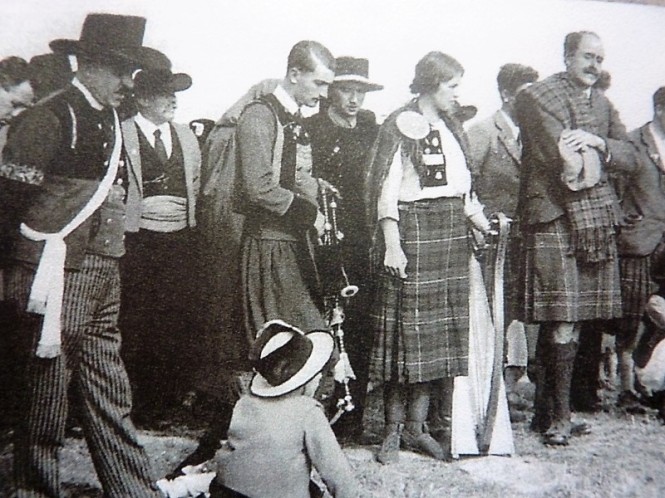
This is the second of the Three Short Pieces by Scottish composer Heloise Russell-Fergusson (1896-1970), which she possibly self-published in 1917.
It is one of the more difficult scores I transcribed, due to the fact that none of the staves counted really 4/4 in the original, and it was not always clear where the left and right hand notes had to be played. I followed the graphical coincidence, i.e. where the notes where aligned in vertical lign I assumed that they had to be played together, even if counting out the note value would not make them align.
Feel free to comment on Musescore or Youtube, if you have suggestions for improvement.
Emilie Julie Candeille was prolific from an early age as composer and performer, actress and author. She appeared before the King aged thirteen, at fourteen was engaged to sing at the Opera, and a year later took the title role in Gluck's Iphigenie en Aulide. Next she became an actress and made her debut at the Comedie Francaise in 1785, and after five years there, joined the Theatre Francaise. She created a sensation there in 1792 as star performer, playright and composer in 154 performances of her operetta Catherine, ou la belle fermiere. She made two unsuccessful marriages, and took to leaving France when life became difficult. As well as her theatre music, she composed several concertos, including two for several instruments, and various piano works. Many of her writings were published.
1. Allegro Maestuoso, D major. 2. Andante gratioso con espressione, G minor. 3. Rondo: Allegro spirituoso, D major
2 ob, 2 hn, string, solo piano. 18 mins
This is her only surviving concerto, and it was published in her lifetime with the quaint spelling of the movement titles listed above. It dates from the year of Haydn's 'Paris' symphonies, and the slow movement certainly suggests she knew her Haydn. It alternates, then varies sections in the minor and major. The outer movements are quite economical with orchestral ideas, though more expansive when the solo has the field to itself. The rondo theme has a happy way of returning in the 'wrong' key, but all is neatly balanced by the end. The whole has a brilliant D major feel, as characteristic in the classical era.
Troi Sonatas pour le Fortepiano avec accompagnement de Violon, Op 1
No 3: Allegro un poco presto, E flat. Andante agitato, C minor. Rondo: Allegretto, E flat
It would be possible to play this work as a piano sonata, though more interesting as a duo. The Andante alternates minor and major episodes (similar to the concerto slow movement). The Finale is a very perky Rondo.
Josepha Barbara AURNHAMMER (1758-1820) "was an Austrian pianist and composer. She was born in Vienna as the eleventh child of Johann Michael Auernhammer and Elisabeth Timmer. Josepha Barbara Auernhammer studied with Georg Friedrich Richter, Leopold Anton Kozeluch and from 1781 Mozart, with whom she fell in love. On 27 June 1781, Mozart wrote of her: "Almost every day after dinner I am at H: v: Auernhammer's - The Miss is a monster! - plays delightfully though, however, she lacks the genuine fine and lilting quality of cantabile; she plucks too much." That year, Mozart dedicated his Violin Sonatas K. 296 and K. 376–80 to her" (Wikipedia).
There is a piece with similar title by Vicente Martín y Soler (1754-1806) in his opera Una Cosa Rara - Act Ii - Sc. XV - Duetto "Pace, Caro Mio Sposo". But there is no obvious relation.
You can find the original sheet music at the IMSLP Petrucci Music Library.
It was transcribed to modern notation by Dan Wanamaker (CC BY 4.0) and digitalized for Musescore and Piano Marvel by Tabea Hirzel.
Find the piece"Pace caro mio sposo" Variation 1 at:
and at
Piano Marvel here and learn to play it.
If you like her music, check out my dedicated list of piano performances on Aurnhammer's compositions.
Did you know that a "scandalized member of the audience originally called Schoenberg's compositions - pure katzenmusik (caterwauling)" and that people considered the young Prokofiev a "crazy man" and the effect of his music as "futuristic katzenjammer".
Katzenmusik is also the title of two compositions by third studio album by the German solo artist Michael Rother which he included in his album 1979 studio album of the same title (Wikipedia, and more).



.jpg)


.jpg)